Locations
Fraud-Click Monitoring

boraware active

Request a Phone Consultation

Select Location *
Name *
Contact *
Preferred Contact Time *
Please write your inquiry. (100 characters max) *
Goldman Urology AI curation background image Goldman Urology AI curation background image
Goldman Urology AI curation icon

AI CURATION

Briefly describe your symptoms
to the smart Goldman AI.

Enter your question.
  • e.g. I urinate frequently and always feel residual urine
  • e.g. I feel a burning pain when I urinate
  • e.g. Itchy, stinging blisters on my genitals

Overactive Bladder

Frequent urination has been disrupting your day.Goldman solves it clearly.

Overactive bladder (OAB): even small symptoms
can have a big impact on daily life.

If you keep needing to urinate frequently, consider the possibility of overactive bladder (OAB).
It is not a disease, but it can make daily life uncomfortable.

SINCE 2002, the hub of AI smart healthcare

SINCE 2002, the hub of AI smart healthcare

SINCE 2002, the hub of AI smart healthcare

SINCE 2002, the hub of AI smart healthcare
What Is Overactive Bladder?

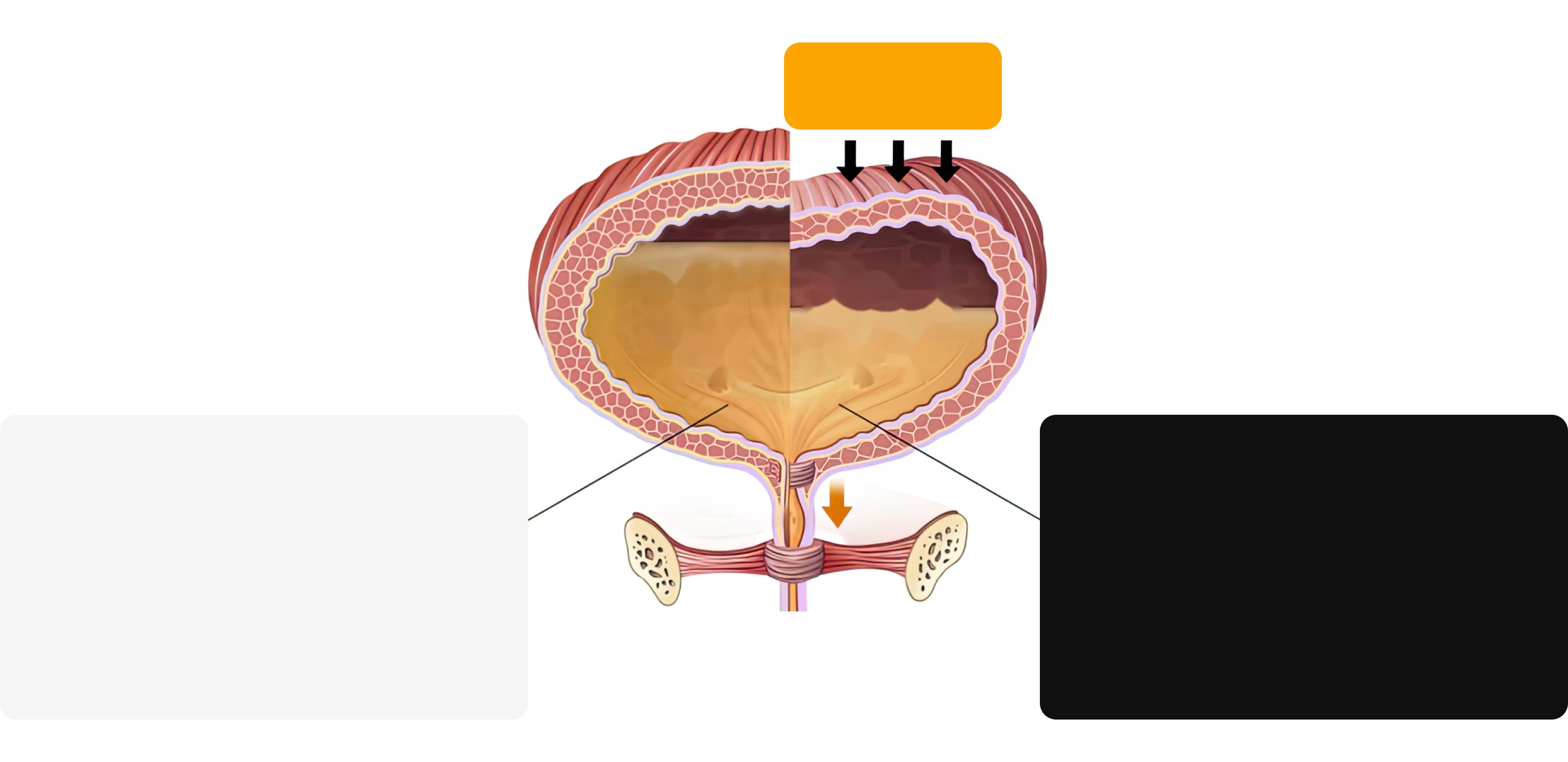
Unlike cystitis, this condition causes frequent urination and a hard-to-hold urge to go without any inflammation.
Normally you feel the need to go only once more than 400ml of urine has collected, but with overactive bladder (OAB) you feel discomfort even with a small amount.
If you urinate 8 or more times a day or experience a sudden urge to urinate, you should suspect overactive bladder.
Normal bladder – no discomfort until full (about 400–500 ml) / Overactive bladder – the detrusor muscle contracts even with little urine, making it hard to holdDetrusor
contraction
NormalOveractiveNo discomfort until
the bladder is full
(about 400-500 ml)
Even a little urine makes
the detrusor contract,
and holding it is hard
Normal bladder – no discomfort until full (about 400–500 ml) / Overactive bladder – the detrusor muscle contracts even with little urine, making it hard to holdDetrusor
contraction
NormalOveractiveNo discomfort until
the bladder is full
(about 400-500 ml)
Even a little urine makes
the detrusor contract,
and holding it is hard

Overactive bladder (OAB): why does it develop?

Overactive bladder (OAB) has many causes, including spinal cord injury, nervous system disorders, and bladder irritation,
and lifestyle factors such as obesity, caffeine, alcohol, smoking, menopause, childbirth, and depression can worsen symptoms, so ongoing management is needed.
  • Brain graphic

    Neurological factors

    Damage to the brain or spinal cord can cause problems
    with bladder control.
  • Muscle structure illustration

    Muscular and anatomical factors

    Symptoms can appear when the bladder muscle contracts excessively
    or the pelvic floor weakens.
  • Woman under stress

    Psychological factors

    Stress or anxiety can irritate the bladder nerves
    and trigger symptoms.
  • Alcohol and cigarettes

    Lifestyle and external irritants

    Irritants such as caffeine, alcohol, and smoking
    can make the bladder more sensitive.
  • Blood glucose meter
    Other factors
    Hormonal changes or chronic conditions such as diabetes
    can also play a role.
Motif image
Overactive bladder (OAB):
what symptoms come with it?
The main symptoms are urinating 8 or more times a day, known as urinary frequency, along with sudden and hard-to-hold urinary urgency and urge incontinence, while nocturia and a sensation of incomplete emptying after voiding are also common.
  • Frequency

    The number of times you urinate increases.
  • Urinary Urgency

    A strong urge to urinate that is hard to hold back.
  • Urgency

    Severe urgency: urine cannot be held and small amounts leak.
  • Nocturia

    You wake at least once during sleep to urinate.
  • Urge Incontinence

    You leak urine before reaching a toilet.
  • Residual Urine Sensation

    You feel as if urine remains even after voiding.

Diagnosing overactive bladder (OAB):
what methods are used?

For overactive bladder (OAB), initial symptoms are assessed through a medical interview and physical examination, followed by a urine test to check for a urinary tract infection (UTI).
If needed, a bladder diary, uroflowmetry, and cystometry (bladder pressure testing) allow a precise diagnosis of overactive bladder.
Medical staff taking a patient history

Medical interview and physical examination

A basic check of voiding habits, symptom onset, and pain location, done first when interstitial cystitis is suspected.
Urinalysis

Urinalysis

Urinalysis is always done to rule out infection.If inflammation is found, a bacterial culture is added; if hematuria is confirmed, further detailed testing may follow.
Medical staff filling out a voiding diary

Keeping a Voiding Diary

Recording when, how much and how often the patient voids, plus incontinence episodes, gives a clearer picture of their condition.It later guides bladder training, diet and fluid intake.
Bladder 3D illustration

Ultrasound Examination

It shows the anatomy of the bladder and urethra, any abnormalities there, and pelvic organ abnormalities overall.
Urodynamic study illustration
Urodynamic Study
This is the most accurate, useful test of bladder function, and also diagnoses stress urinary incontinence.

Treating overactive bladder (OAB):
how is it carried out?

Treatment for overactive bladder (OAB) combines improved voiding habits with medical (drug) therapy,
requires 3 to 6 months of consistent care, and starting early improves results.
  • Medication Therapy

    Medication calms bladder muscle overactivity from impaired self-regulation, reducing frequency and urge incontinence and increasing voided volume.
  • Pelvic Floor Muscle Exercises (Kegel Exercises)

    Contracting the pelvic floor suppresses reflex detrusor contraction and prevents leakage, so strengthening these muscles helps you handle sudden urges.
  • Lifestyle Modification

    Diet control, weight management, quitting smoking, and voiding before going out and before bed help relieve frequency, urgency, and urge incontinence.
  • Biofeedback

    Visual, auditory, and tactile feedback confirms the right muscles are being used, so patients exercise correctly and gain voluntary control.
  • Bladder Training

    Effective for frequency, urgency, and urge incontinence with no organic cause; it corrects faulty voiding habits and teaches normal bladder function.
  • Improving the Voiding Environment

    A bladder diary identifies voiding intervals and patterns; the patient then voids at set times, before leakage occurs.Mainly used to improve voiding habits in older adults.
Bladder 3D illustration

With customized, integrated treatment,
we care for the discomfort of overactive bladder (OAB) from the root.

Through Goldman's systematic testing, multifaceted treatment,
and lifestyle improvement, we relieve symptoms and support healthy voiding without recurrence.

Combined Customized Behavioral Therapy

We add behavioral therapy suited to each patient's condition, such as voiding-habit correction and pelvic floor muscle exercises.

A Range of Treatment Options

From medications that calm bladder muscle overactivity to those for pain and symptom relief, we use a wide range of medications systematically.

Integrated Care Including Lifestyle Correction

Dietary control, weight management, and quitting smoking keep symptoms from worsening.

Accurate Voiding Pattern Analysis and Training

A bladder diary and biofeedback therapy let us analyze voiding habits in detail, guiding the bladder back to normal function.

Ongoing Follow-Up and Personalized Consultation

Ongoing monitoring and communication with the patient keep treatment optimized for maximum effect.

Have questions about overactive bladder? Get answers now.

Goldman's know-how gives clear answers to patients' questions.
  • Overactive bladder can occur in both men and women.
    It is especially common in women and older adults.

  • A full cure is often difficult, but proper treatment and management greatly relieve symptoms.

  • See a specialist immediately if symptoms suddenly worsen, you see blood in your urine, or you have pain.

  • Yes.Pelvic floor muscle exercises (Kegel exercises) in particular help improve bladder control.

  • Overactive bladder is a functional disorder: the bladder becomes oversensitive without infection, causing frequent urination (frequency), a sudden urge that is hard to hold (urgency), and incontinence.Cystitis is inflammation from bacterial infection, with burning or painful urination, a feeling of residual urine, lower abdominal discomfort, and in severe cases fever or hematuria.The symptoms look similar but the causes differ entirely, so Goldman Urology first confirms whether infection is present with urinalysis and, if needed, further tests, then sets the treatment direction.

Real treatment stories
as told by patients and medical staff

From the start of treatment to recovery!Real stories build trust.

More Treatment Cases
It’s Advanced!

TOP 7 Reasons Goldman Leads

GOLDMAN Special 7

1
7
  • Surgery scene
    Urology Only

    25 Years

    1
  • Reviewing treatment data
    Unrivaled Treatment Data

    2 Million+

    2
  • Specialist during surgery
    BPH Surgery Data

    6,500+

    3
  • Urinary stone treatment equipment
    Urinary Stone Treatment Data

    10,000+

    4
  • HoLEP surgery equipment
    Nationwide HoLEP Surgeries

    40.8% Performed

    5
  • Goldman Urology Clinic medical staff
    Experienced Medical Team

    25 Years of Clinical Experience

    6
  • AI symbolic image
    From Diagnosis to Surgery

    State-of-the-Art AI System

    7

Urological concerns?
Solve them at a Goldman near you.

If you consent to the use of location information, you can find the Goldman branch closest to you.